Like Amazon before it, Alibaba proved that a global shopping empire is a suitable launchpad for a cloud platform. Founded in 1999 as an e-commerce company, Alibaba Group launched Alibaba Cloud a decade later in September 2009. It has since become the largest cloud provider in the Asia Pacific. Despite its roots in mainland China, Alibaba Cloud has expanded globally, with data centers across Asia, Europe, the Middle East, and the Americas. However, its core customer base remains in China, where it commands roughly 39% of the cloud infrastructure market.
If you’re operating in Asia Pacific, Alibaba Cloud isn’t your only option—and the range of Alibaba Cloud alternatives is wider than you might think. Hyperscalers like AWS, Microsoft Azure, and Google Cloud have a strong regional presence, but so do specialized providers. DigitalOcean, for example, operates data centers in Singapore and Bangalore, alongside a global footprint, helping achieve low-latency performance in the region without the hyperscale complexity. Whether you’re looking at other Asia-based providers or globally distributed platforms with a regional presence, the options ahead are worth exploring.
Key takeaways:
-
Alibaba Cloud alternatives are cloud infrastructure providers—whether hyperscalers, specialized developer platforms, or region-specific clouds—that also operate in the Asia Pacific and can serve as a replacement or complement to Alibaba Cloud for compute, storage, networking, and AI workloads.
-
You might evaluate Alibaba Cloud alternatives to improve workload portability, expand regional coverage, strengthen governance controls, or support evolving multi-cloud strategies.
-
When assessing Alibaba Cloud alternatives, consider factors such as global region availability, networking architecture, GPU support, pricing transparency, compliance capabilities, and SLA commitments.
-
Alibaba Cloud alternatives include DigitalOcean, Amazon Web Services (AWS), Microsoft Azure, Google Cloud, IBM Cloud, Oracle Cloud Infrastructure, Tencent Cloud, Huawei Cloud, and Vultr.
What is Alibaba Cloud?
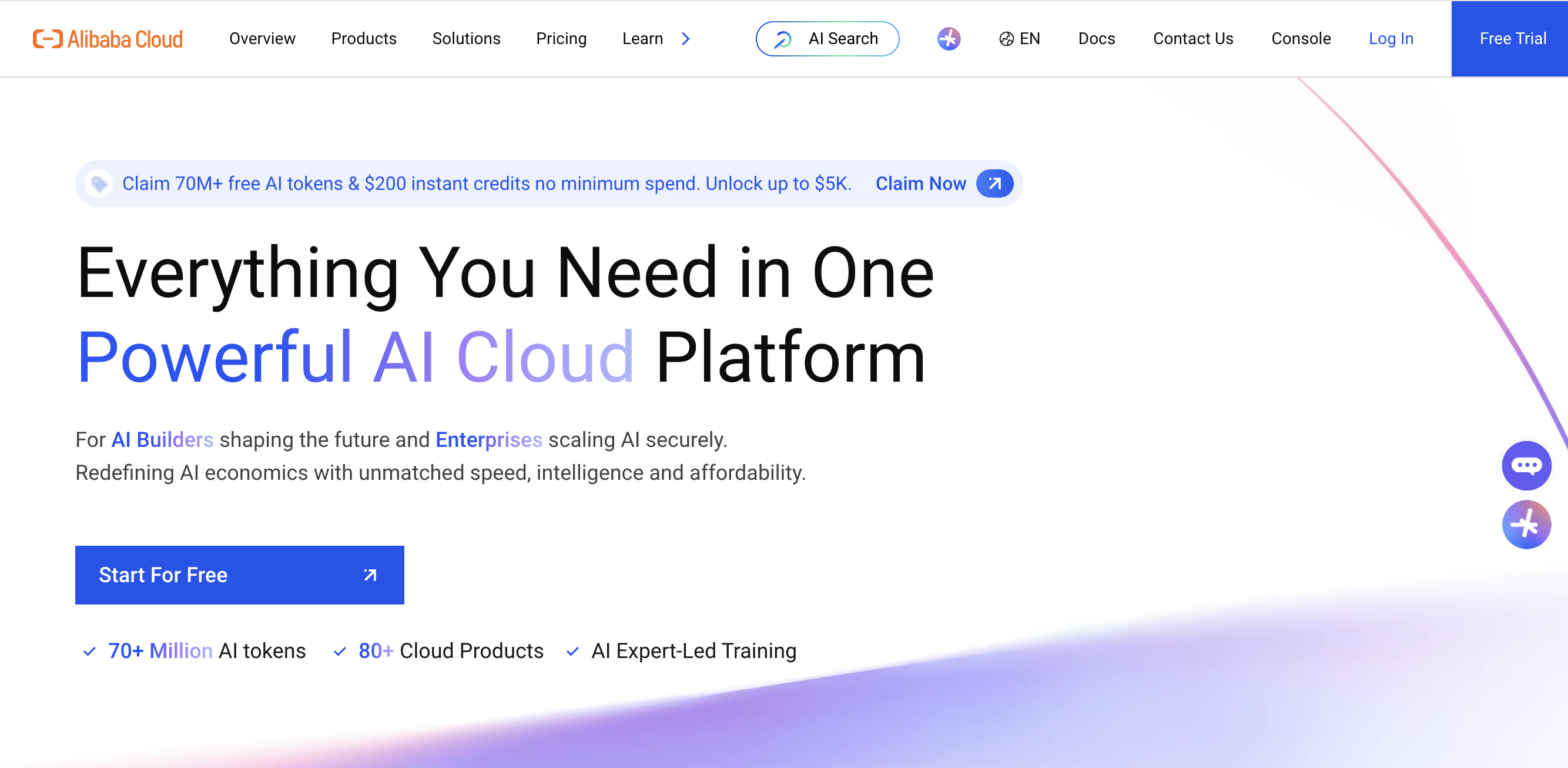
Alibaba Cloud is a global cloud computing platform that provides infrastructure, data, and AI services for building and operating applications at scale. It offers compute, storage, networking, and databases through a unified cloud environment that supports both traditional and cloud-native architectures. On the AI side, Alibaba Cloud offers GPU-accelerated compute instances and managed machine learning pipelines through its PAI platform. Alibaba Cloud also develops its own family of AI models—the open-source Qwen series, which now includes multimodal LLMs, coding models, and vision models available through its Model Studio platform and via API. The platform is widely used across Asia-Pacific markets and supports organizations deploying applications across multiple regions. Teams may turn to Alibaba Cloud for GPU-accelerated compute, managed Kubernetes, and cross-region database replication—particularly when deploying latency-sensitive applications across Asia Pacific availability zones.
Alibaba Cloud key features:
-
Apsara distributed architecture is designed to support large-scale cluster management with built-in fault isolation and resource pooling across infrastructure environments.
-
Cloud Enterprise Network (CEN) provides centralized connectivity across multiple Virtual Private Clouds (VPCs), optimizing cross-region routing and bandwidth management.
-
Server Load Balancer (SLB) and Global Traffic Manager (GTM) support traffic distribution and DNS-level routing to help maintain application availability across availability zones and geographic deployments.
-
ECS instances - $4.55/month starting for economy instance e with 2 cores, 0.5 GB memory, 40 G Standard ESSD, and 200Mbps bandwidth
-
Serverless App Engine - $0.000006859/CU starting for pay-as-you-go, or $6.85/year starting for resource plans with 1 million CU
-
GPU instances - $2.26/hour for ecs.gn8is.2xlarge GPU-accelerated compute-optimized instance with 8 vCPUs and 64 GiB RAM
Curious how modern multimodal AI models are built and deployed? Explore An Overview of Alibaba’s Multimodal Model: Ovis-U1 to learn how the open-source 3B-parameter model supports multimodal understanding, text-to-image generation, and image editing workflows. The tutorial also walks through running Ovis-U1 on GPU infrastructure for experimentation and development.
Benefits of Alibaba Cloud alternatives
Alibaba Cloud checks a lot of boxes, but every provider has trade-offs. These are the areas where alternatives might pull ahead depending on your stack and priorities:
-
Expanded hyperscale ecosystem access: Other clouds may offer larger marketplaces and broader third-party integrations for monitoring, analytics, and DevOps workflows. This ecosystem depth simplifies connecting infrastructure with the operational tools your team uses.
-
Greater workload portability: You might find stronger support for standardized APIs, Kubernetes-native tooling, and open cloud frameworks that simplify cross-platform deployment. These capabilities make it easier for your team to migrate services or adopt multi-cloud strategies without extensive refactoring.
-
Improved service specialization: Many cloud environments focus on targeted infrastructure areas such as AI accelerators, edge networking, or high-performance compute clusters. Choosing a platform optimized for your particular workload type can improve application performance and operational efficiency.
-
Stronger enterprise governance tooling: Some providers offer more mature IAM frameworks, policy automation, and built-in compliance tooling than what’s available on Alibaba Cloud. These features matter most for large teams managing access controls, enforcing security policies, and meeting regulatory requirements across multiple environments.
-
Infrastructure model diversity: Combinations of shared virtual machines, dedicated hosts, and bare metal often exist within unified networking environments. This range of deployment models supports architectures designed around workload performance, isolation, and cost requirements.
How to choose the right Alibaba Cloud alternative
Maybe you’re already on Alibaba Cloud and starting to wonder if there’s a better fit. Or you’re going multi-cloud and need a second provider that can hold its own in the same regions without doubling your operational overhead. Either way, here’s what to focus on when evaluating your options:
-
Geographic coverage and regional availability: Alibaba Cloud has one of the strongest data center footprints in Asia-Pacific, with regions spanning China, Southeast Asia, Japan, South Korea, and India. If low latency in APAC markets is a priority for your application, check whether any alternative you’re considering actually has data centers in the regions you need.
-
Architecture compatibility: Evaluate each provider’s instance types, hypervisor technologies, container orchestration support, and database services. Infrastructure with compatible components reduces migration complexity and minimizes the need for extensive application refactoring.
-
Operational tooling maturity: Assess the quality of APIs, CLI tooling, infrastructure-as-code integrations, and observability features available on each platform. Mature automation and monitoring capabilities simplify deployment and maintain consistent DevOps workflows.
-
Resilience architecture: Examine how providers structure availability zones, backup automation, and disaster recovery mechanisms. Clear SLAs and multi-region redundancy options strengthen service continuity during infrastructure failures or regional disruptions.
-
Cost structure and pricing transparency: Look beyond entry-level pricing and evaluate billing transparency, resource reservation models, and cost monitoring tools. Providers with predictable pricing and straightforward billing structures can make it easier for your team to manage infrastructure costs as workloads scale.
AI/GPU workload comparison
AI workloads introduce specialized infrastructure demands that differ significantly across cloud infrastructure providers. When evaluating Alibaba Cloud alternatives for AI, focus on accelerator architecture and system-level design:
-
GPU interconnect architecture: Compare NVLink, PCIe lane allocation, and RDMA cluster networking support for distributed model training efficiency.
-
Dedicated versus shared GPU allocation: Some providers offer single-tenant GPU nodes, while others use shared virtualization layers, which can impact performance predictability.
-
Accelerator ecosystem breadth: Review the availability of NVIDIA, AMD, or TPU accelerators depending on framework compatibility requirements.
-
High-throughput storage coupling: AI training depends on rapid ingestion from object storage or parallel file systems. Evaluate how tightly storage tiers integrate with GPU clusters.
-
Regional GPU supply distribution: Verify whether AI accelerators are available across multiple markets to support data sovereignty, cloud compliance, and geographic redundancy.
Top 10 Alibaba Cloud alternatives
Alibaba Cloud alternatives include cloud infrastructure providers offering scalable compute, storage, networking, and AI services across different regions and compliance environments. The following platforms vary in architecture depth, pricing transparency, GPU availability, and enterprise capabilities, making them suitable for different workload priorities.
Pricing and feature information in this article are based on publicly available documentation as of March 2026 and may vary by region and workload. For the most current pricing and availability, please refer to each provider’s official documentation.
*This “best for” information reflects an opinion based solely on publicly available third-party commentary and user experiences shared in public forums. It does not constitute verified facts, comprehensive data, or a definitive assessment of the service.
| Provider | Best for* (use cases) | Key features | Pricing |
|---|---|---|---|
| Alibaba Cloud | Asia-Pacific AI workloads | ECS custom instance families; ACK managed Kubernetes; ApsaraDB portfolio (PolarDB, Tair); Model Studio with Qwen ecosystem | ECS from $4.55/mo; SAE from $6.85/yr; GPU from $2.26/hr |
| DigitalOcean | AI application infrastructure | Managed Kubernetes with autoscaling; Project-based VPC isolation; GPU Droplets® with dedicated PCIe access; API-first control plane | Droplets - $4/month; App Platform - $0/month for static sites (subject to applicable terms and conditions); GPU Droplets - $1.49/GPU/hour |
| Vultr | High-frequency compute | High-frequency CPU instances; Dedicated cloud and bare metal; Global Anycast networking; NVMe block storage | Compute from $5/mo; GPU from $2.99/hr |
| AWS | Multi-region distributed systems | Availability Zone fault isolation; Graviton processors and Nitro system; Granular IAM policies; Extensive managed services | EC2 from $6.13/mo; App Runner from $0.007/vCPU-hr; GPU from $6.88/hr |
| Microsoft Azure | Hybrid enterprise governance | Azure Arc hybrid control; Entra ID identity governance; Confidential computing; Specialized VM series | VMs from $6.13/mo; App Service free (F1) or from $9.49/mo; GPU from $8.82/hr |
| Google Cloud | Data warehouse analytics | Live VM migration; Andromeda SDN; BigQuery serverless warehouse; TPU accelerator options | Compute from $6.11/mo; App Engine from $0.05/hr; GPU from $88.49/hr |
| IBM Cloud | Financial services compliance environments | IBM Cloud Satellite; Single-tenant bare metal; Managed OpenShift clusters; Financial compliance framework | VMs from $53.29/mo; GPU from $85/hr |
| Oracle Cloud Infrastructure | Enterprise database performance | Non-oversubscribed bare metal; RDMA HPC networking; Autonomous Database; Flexible OCPU sizing | Dense I/O E5 - $0.03/OCPU/hour; Virtual Machine Standard X7 - $0.0638/OCPU/hour; VM GPU (NVIDIA P100) - $1.275/GPU/hour |
| OVHcloud | European data sovereignty | EU-based data centers; Hosted private cloud; Built-in DDoS mitigation; vRack private networking | Instances from $8.59/mo; GPU from $4.59/hr |
| Tencent Cloud | High-concurrency gaming platforms | Global Application Acceleration; TDSQL distributed database; EdgeOne CDN and security; High-concurrency compute scaling | Compute Instances - $19.20/month |
| Huawei Cloud | Telecom-integrated cloud | CloudMatrix AI clusters; GaussDB distributed database; CloudCampus hybrid networking; Enterprise big data services | Compute Instances - $17.03/month; GPU-accelerated - $282.67/month |
Cloud platforms for modern application infrastructure
These platforms provide core cloud services such as virtual machines, managed Kubernetes, object storage, and networking, forming the foundation for running modern production applications. They are designed to support scalable web platforms, containerized workloads, and distributed systems with predictable performance and clear infrastructure management.
1. DigitalOcean with AI application infrastructure
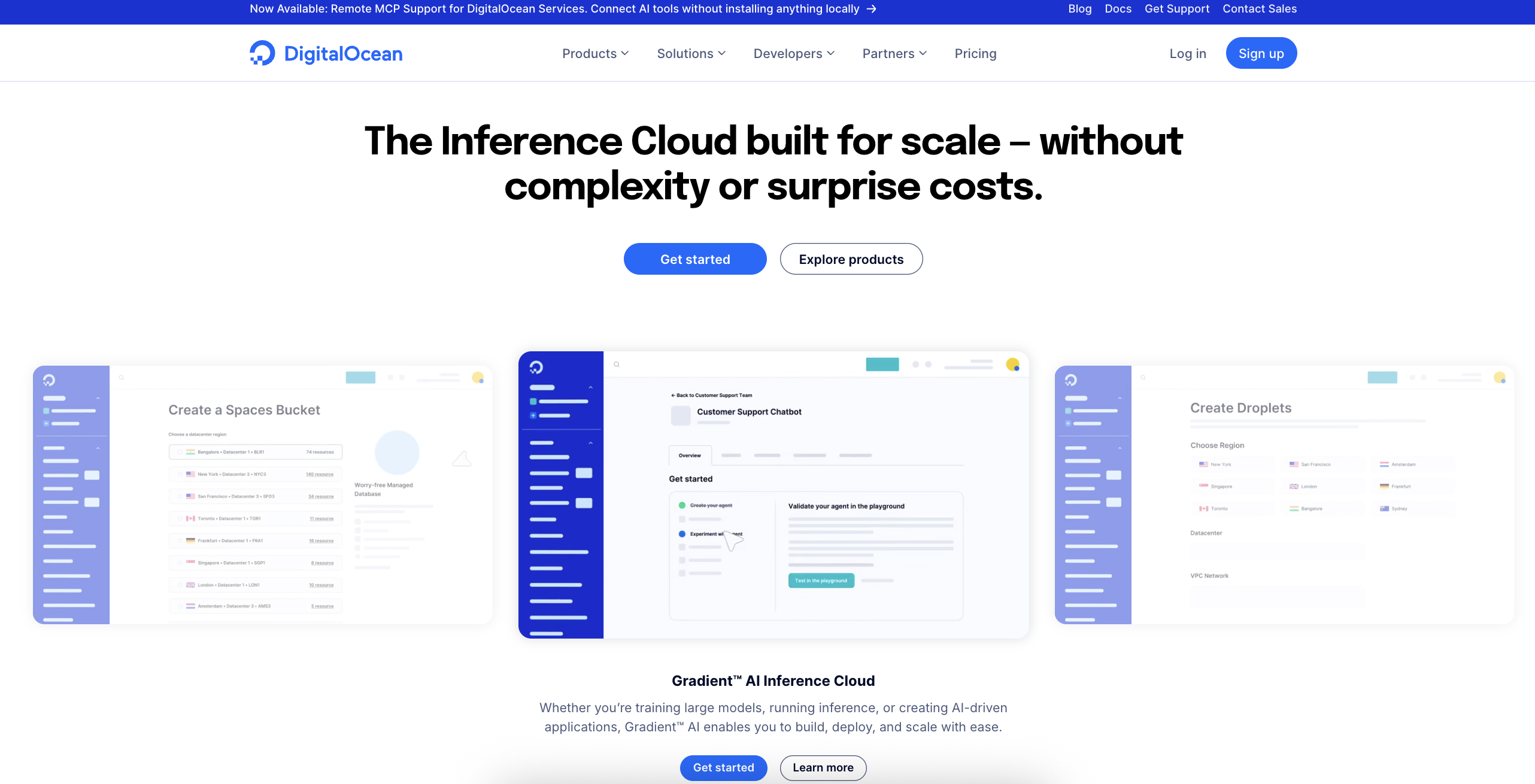
DigitalOcean’s Gradient™ AI Inference Cloud is built for digital-native enterprises and AI-native companies running production web applications and AI-driven application workloads. Its product offering includes virtual machines, Managed Kubernetes, distributed networking, Managed Databases, and GPU-backed compute through a unified control plane that minimizes operational overhead. Teams often consider it when they want scalable cloud infrastructure without the operational complexity typically associated with hyperscale platforms. The platform supports globally distributed deployments across its expanding cloud data centers, including multiple locations in Asia, making it suitable for organizations planning region-aware application rollouts and low-latency deployments for Asia-Pacific users. DigitalOcean balances infrastructure flexibility with operational clarity, enabling teams to scale modern workloads while maintaining predictable performance characteristics.
DigitalOcean key features:
-
Fully managed PostgreSQL, MySQL, and Redis with automated failover, point-in-time recovery, and cross-region replication for resilient database architectures.
-
GPU Droplets® provide on-demand access to NVIDIA H100 instances with high-bandwidth memory and dedicated PCIe access, enabling low-latency model inference and AI-powered application features in production environments.
-
Managed Kubernetes with autoscaling node pools, integrated load balancers, and VPC-native networking for production-grade container orchestration.
-
Droplets - $4/month starting for basic VMs with 512 MiB memory, 1 vCPU, 10 GiB SSD, and 500 GiB transfer
-
App Platform - $0 for static sites, subject to applicable terms and conditions; $5/month starting for basic web apps with automatic scaling and built-in CI/CD
-
GPU Droplets - $3.39/GPU/hour on-demand for NVIDIA H100 GPU instances, or $1.99/GPU/hour with a 12-month commitment
2. Vultr with high-frequency compute
Vultr delivers high-performance cloud compute designed for teams that require infrastructure-level configurability and rapid global deployment. Its platform offerings span virtual machines, dedicated bare metal, and GPU-accelerated instances distributed across a network of cloud data centers. Vultr emphasizes direct hardware access and minimal abstraction, giving teams greater control over infrastructure configuration and workload performance. The platform offers deterministic compute behavior and granular control, making it suitable for AI inference, edge deployments, and performance-sensitive production systems. Vultr also operates multiple data center locations across Asia—including Japan, India, and South Korea—supporting deployments that require regional proximity and lower latency for users in the Asia-Pacific market.
Vultr key features:
-
Vultr enables shared GPU configurations that help teams to allocate a portion of a physical GPU for smaller inference jobs, reducing overprovisioning while maintaining hardware acceleration.
-
Bare metal servers provide CPU, memory, and storage resources with no hypervisor layer, supporting consistent throughput and compliance-sensitive environments.
-
Users can upload proprietary OS images or hardened appliances and replicate them through snapshot-based cloning, enabling reproducible infrastructure rollouts across regions.
-
Cloud Compute - $5/month starting for Shared CPU with 1 GB RAM, 1 vCPU, 25 GB SSD
-
GPU instances - $2.99/hour on-demand for NVIDIA H100 GPU instances
If you’re outgrowing what Vultr provides, read our Vultr alternatives guide. We cover providers with stronger managed databases, built-in monitoring, and more opinionated deployment workflows.
Global hyperscale cloud platforms
AWS, Azure, and Google Cloud all operate data centers across the Asia Pacific, so they can typically match Alibaba Cloud’s regional coverage. The tradeoff is complexity—their service catalogs are massive, and costs can spiral without dedicated FinOps oversight.
A hyperscaler cloud provides massive global infrastructure and extensive service catalogs, but not every team requires the scale or operational overhead of these platforms. Other cloud providers vary in pricing models, infrastructure scope, developer tooling, and day-to-day operational complexity. You can choose among the hyperscaler cloud providers that suit your needs better.
3. AWS with a multi-region distributed system
 Amazon Web Services is a global cloud platform offering extensive compute, storage, managed databases, networking, and AI services across a large international infrastructure footprint. AWS has deep service specialization and a mature ecosystem of integrations. Its architecture supports highly distributed deployments, complex enterprise workloads, and advanced automation patterns. Teams conducting migration planning from region-focused providers often land on AWS because of its global coverage, granular service controls, and wide range of core infrastructure services.
AWS key features:
-
AWS enables tightly coupled cluster networking within Availability Zones using Placement Groups and EFA, supporting high-performance computing (HPC) and distributed AI training jobs.
-
Services such as Route 53 and cross-region replication help traffic distribution and data synchronization across continents, improving resilience and failover design.
-
AWS provides structured pricing commitments that help organizations optimize long-term compute expenditure while maintaining workload flexibility.
-
EC2 instances - $6.13/month for t4g.micro shared instance with 2 vCPUs, 1 GB RAM, EBS-only storage, and up to 5 Gbps network
-
App Runner - $0.007/vCPU-hour and $0.007/GB-hour starting for active container instances, with configurations ranging from 0.25 vCPU/0.5 GB to 4 vCPU/8 GB
-
GPU instances - $6.88/hour on-demand for p5.4xlarge GPU instance with 16 vCPUs, 256 GiB RAM, 100 Gigabit network, and 1x 3840 GB SSD
AWS has the broadest service catalog in the cloud, but that breadth sometimes comes with pricing complexity, operational overhead, and a learning curve that not every team needs to absorb. AWS alternatives can offer simpler operational models, more predictable billing, and focused feature sets that can be a better fit for teams that don’t need 200+ services.
4. Microsoft Azure with hybrid enterprise governance
Microsoft Azure delivers enterprise-grade infrastructure engineered for hybrid and globally distributed environments. It integrates compute, analytics, AI services, and identity management under a policy-driven governance model. Teams consider Azure when hybrid control, directory integration, and enterprise compliance enforcement are key requirements. Microsoft Azure has a broad geographic presence and support for regulated industries such as healthcare, financial services, government, and telecommunications. Its architecture supports both modern cloud-native systems and legacy-connected enterprise applications.
Microsoft Azure key features:
-
Azure Arc extends Azure governance and policy controls to on-premises servers and other cloud environments, enabling centralized configuration enforcement.
-
Azure supports fault-domain and update-domain isolation to reduce correlated infrastructure failures within regions.
-
Azure Policy and Blueprints automation enable large-scale resource standardization and compliance rule enforcement across subscriptions.
-
Virtual machines - $6.132/month for basic B2ts v2 series (pay-as-you-go pricing)
-
Azure App Service - $0 for F1 Free Plan; $9.49/month per site for D1 Shared Plan
-
Cloud GPUs (H100) - $8.820/hour for NC40ads H100 v5 with 40 vCPUs, 320 GB RAM, 3576 GB temporary storage
Teams looking for cloud platforms with clearer pricing structures and less operational overhead may explore Azure alternatives. While Azure supports complex enterprise environments, other providers may align better with teams that prioritize focused infrastructure capabilities and predictable cost models.
5. Google Cloud Platform with data warehouse analytics
Google Cloud Platform (GCP) is architected for distributed systems, large-scale data processing, and AI-driven application development. It combines scalable compute, managed Kubernetes, serverless runtimes, and advanced machine learning services delivered over Google’s private global backbone network. If your stack is built heavily on Kubernetes or your team depends on BigQuery-level analytics performance, GCP is probably already on your radar. Teams also deploy it for globally synchronized workloads and data-intensive services that depend on high-throughput inter-region networking.
GCP key features:
-
Compute Engine supports live migration during host maintenance, reducing downtime without requiring application-level failover design.
-
Projects, folders, and organization-level policies enable granular segmentation of environments and access controls.
-
Fully managed, columnar data warehouse that separates storage and compute, enabling independent scaling for high-volume analytical workloads.
-
Compute Engine - $6.11/month for e2-micro shared instance with 2 vCPUs and 1 GiB RAM
-
App Engine - $0.05–$0.10/hour per instance, depending on environment (Standard or Flexible) and instance class, with free tier quotas available
-
GPU instances - $88.49/hour on-demand for A3-highgpu-8g instance with 8 GPUs, 208 vCPUs, and 1872 GiB RAM
Google Cloud brings strong AI/ML and data analytics tooling, but its sprawling service catalog and steep learning curve can be challenging to navigate. If you’re looking for something leaner, Google Cloud alternatives cover providers with focused infrastructure and less operational overhead.
Enterprise and hybrid-focused cloud providers
These providers specialize in hybrid cloud deployments, enterprise application support, and regulated industry environments. They offer strong integration with legacy systems and enterprise software stacks. You’ll find support for governance, compliance, and mission-critical workloads across industries such as financial services, government, and large-scale database environments.
6. IBM Cloud with focused compliance environment
IBM Cloud is designed for enterprise and hybrid deployments that require integration with existing mainframes and private data center infrastructure. It supports virtual servers, bare-metal provisioning, and container orchestration across hybrid architectures that span public and private environments. If your team operates in a heavily regulated industry or needs hybrid portability between on-prem and cloud, IBM Cloud is worth a serious look. Its architecture prioritizes secure connectivity, encryption, and policy enforcement across distributed enterprise systems.
IBM Cloud key features:
-
Satellite enables applications to be deployed and managed consistently across on-premises, edge, and public cloud environments.
-
Hardware security module (HSM)-backed encryption key management supports regulated workloads requiring strict key custody controls.
-
Offers preconfigured compliance controls aligned with financial regulatory standards, reducing implementation overhead for regulated industry workloads.
-
Virtual Servers for VPC - $53.29/month for nxf-2x1 Flex instance with 2 vCPUs, 1 GB RAM, and 2 Gbps bandwidth
-
GPU instances - $85.00/hour for a GPU virtual server instance with 8x H100 GPUs, 160 vCPUs, 1792 GiB RAM, 61440 GB storage, and 200 Gbps network
Not every team requires deep legacy integration or complex governance frameworks. IBM Cloud alternatives highlight providers that vary in operational simplicity, pricing transparency, hybrid capabilities, and global infrastructure reach.
7. Oracle Cloud Infrastructure with enterprise database performance
Oracle Cloud Infrastructure (OCI) is optimized for database-intensive, transaction-heavy enterprise environments that require deterministic performance. It offers predefined compute shapes, high-throughput networking, and tightly integrated database services tailored for Oracle workloads. OCI is deeply optimized for Oracle database and ERP workloads, with migration tooling that supports moving on-prem Oracle environments to the cloud without rearchitecting. It also offers hybrid deployment options like Cloud@Customer, which runs OCI services inside your own data center.
OCI key features:
-
Provides automated indexing, performance tuning, patching, and threat detection to reduce administrative overhead.
-
Supports ultra-low-latency communication for analytics clusters and high-performance computing environments.
-
OCI can deploy isolated, single-tenant cloud regions for government or highly regulated industries.
-
Dense I/O E5 - $0.03 per OCPU/hour
-
Virtual Machine Standard- X7 - $0.0638 OCPU/hour
-
VM GPU (NVIDIA P100) - $1.275/GPU/hour
Regional and market-specific cloud providers
Some providers focus on specific regions rather than a global scale. OVHcloud, Tencent Cloud, and Huawei Cloud each serve distinct markets—Europe, China, and Asia/Middle East, respectively—with infrastructure and compliance tailored to each market.
8. OVHcloud with European data sovereignty
OVHcloud is a European cloud provider with infrastructure sovereignty and regional operational control. It designs and operates its own hardware and cloud data centers, enabling vertical integration across compute, networking, and cooling systems. OVHcloud is EU-owned, SecNumCloud-certified, and not subject to the US CLOUD Act—making it one of the strongest options for organizations with strict European data sovereignty requirements. Its model combines public cloud, hosted private cloud, and bare metal infrastructure, much of it tailored to regulatory-conscious markets.
OVHcloud key features:
-
Custom-designed cooling systems increase hardware density and thermal efficiency within OVH-operated facilities.
-
Network-layer mitigation is embedded into its backbone, reducing the need for third-party protection services.
-
Delivers isolated virtualized infrastructure environments with enterprise-grade virtualization controls.
-
Public Cloud Instances - $8.59/month starting for shared-resource instances with 2 GB RAM, 1 vCore, and 25 GB storage
-
AI Training GPUs - $4.59/hour starting for NVIDIA H100 GPU instances
OVHcloud is often considered by teams prioritizing European data sovereignty and dedicated infrastructure, but not every workload requires region-specific hosting. OVHcloud alternatives highlight providers that differ in global infrastructure reach, compliance capabilities, managed service offerings, and architectural flexibility.
9. Tencent Cloud with a high-concurrency gaming platform
Tencent Cloud is the second-largest cloud provider in China and a direct competitor to Alibaba Cloud in the domestic market. It integrates tightly with WeChat Mini Programs, WeChat Pay, and Tencent’s gaming and media stack, making it a stronger fit for consumer-facing apps that depend on social, payments, or content delivery. The platform also delivers compute, storage, database, AI, and content distribution services designed to support large-scale digital workloads within regionally concentrated deployments. Outside China, Tencent Cloud’s data center footprint is smaller than Alibaba Cloud’s, so teams that need multi-region coverage across APAC or globally may find it limiting.
Tencent Cloud key features:
-
Provides intelligent traffic routing and latency-based path optimization across cross-border networks, improving performance for international user bases accessing applications hosted within China.
-
Offers a horizontally scalable, financial-grade distributed database system with multi-active deployment capabilities and strong consistency controls.
-
Combines content delivery, DDoS protection, Web Application Firewall (WAF), and edge computing into a unified edge distribution framework.
- Compute Instances - $19.20/month for a 2 vCPU, 2 GB memory Cloud Virtual Machine (CVM) instance.
10. Huawei Cloud with telecom-integrated cloud
Huawei Cloud is the cloud arm of Huawei, the Chinese telecom and electronics giant known for its smartphones, 5G network equipment, and enterprise hardware. That infrastructure background shapes its cloud platform, which focuses heavily on telecommunications, manufacturing, and public sector digital transformation across Asia, the Middle East, and emerging markets. It maintains strong infrastructure coverage within China and an expanding presence in emerging markets, though it has little to no presence in North America or Western Europe. Its AI play is also distinct: Huawei’s Pangu model family is purpose-built for industry verticals like manufacturing, mining, and autonomous driving rather than general-purpose use, and runs on Huawei’s own Ascend chips. The platform supports AI workloads, big data processing, and industry-adapted infrastructure stacks optimized for performance-intensive environments.
Huawei Cloud key features:
-
Delivers high-performance AI cluster architecture designed for large-scale model training and inference with high-speed interconnects and optimized resource scheduling.
-
Enterprise-grade distributed relational database supporting high availability, cross-region replication, and large transaction volumes.
-
Extends cloud management into on-premises campus networks through centralized orchestration, enabling hybrid enterprise networking control.
-
Compute Instances - $17.03/month for a 1 vCPU, 1 GB memory Elastic Cloud Server (ECS) instance.
-
GPU-accelerated - $282.67/month for a 4 vCPU, 16 GB memory Elastic Cloud Server (ECS) GPU instance with 1× NVIDIA T4 (16 GB VRAM)
Alibaba Cloud alternatives FAQ
Which cloud provider is most similar to Alibaba Cloud?
Providers with large regional infrastructure and integrated compute, storage, and AI services—such as Amazon Web Services and Microsoft Azure—offer capabilities similar to Alibaba Cloud. However, if you’re prioritizing simplified operations and predictable pricing, DigitalOcean offers comparable core infrastructure with less operational overhead and a data center presence in Asia.
What factors should I consider when choosing an Alibaba Cloud alternative?
Start with geographic coverage— if your users are in China or Southeast Asia, many Western providers won’t match Alibaba Cloud’s regional footprint, so confirm that any alternative actually operates data centers where you need them. From there, evaluate pricing transparency, migration complexity, managed service depth (especially databases and Kubernetes), and whether the provider’s documentation and support meet your team’s needs.
Which alternative is best for enterprise workloads?
The best alternative depends on your specific workload needs. Hyperscalers like AWS and Azure typically appeal to large enterprises that need hundreds of services and deep compliance frameworks. DigitalOcean is built for digital native enterprises and AI-native enterprises that want modern infrastructure, GPU compute, managed Kubernetes, and AI tooling on a single platform with transparent pricing and no operational bloat.
Is it difficult to migrate from Alibaba Cloud to another provider?
Migration complexity depends on your existing architecture, especially networking design, database engines, and container orchestration layers. DigitalOcean provides migration services that support moving applications, databases, and workloads from other platforms.
Is Alibaba Cloud cheaper than DigitalOcean?
Entry-level compute pricing is similar. Basic Elastic Compute Service (ECS) instances on Alibaba Cloud start at about $4.55/month, while Droplets from DigitalOcean start at $4/month. However, the total cost varies by region, instance type, and scaling model.
Power modern cloud infrastructure with DigitalOcean
Deploy and scale web applications, APIs, databases, and containerized services on DigitalOcean. Run production workloads using virtual machines, managed Kubernetes clusters, managed databases, scalable storage, and integrated networking, along with GPU infrastructure that supports machine learning and AI-powered applications.
DigitalOcean provides a unified environment for building and operating modern infrastructure without the operational complexity common in large hyperscale platforms. From microservices architectures and SaaS applications to data pipelines and AI inference workloads, you can provision compute, storage, and networking resources in minutes and scale them as demand grows. Manage everything through a streamlined control panel, CLI, or API while maintaining visibility across your infrastructure.
Key features:
-
Flexible cloud virtual machines with multiple CPU, memory, and storage configurations designed for everything from lightweight services to high-performance application workloads
-
Fully managed Kubernetes clusters with automatic updates, autoscaling, and integrated load balancing for containerized applications
-
Production-ready PostgreSQL, MySQL, MongoDB, Kafka, Valkey, and OpenSearch deployments with automated backups and high availability
-
S3-compatible Spaces object storage and scalable block storage volumes for application assets, backups, and large datasets
-
Built-in VPC networking, load balancers, firewalls, DNS, and monitoring tools for helping to build secure production environments
-
GPU Droplets are designed for machine learning training, AI inference pipelines, and high-performance compute workloads
Start building on DigitalOcean today and deploy reliable cloud infrastructure for modern applications and distributed systems. For larger deployments, dedicated infrastructure, or advanced GPU configurations, you can contact the DigitalOcean team to explore solutions tailored to your cloud and AI workloads.
Any references to third-party companies, trademarks, or logos in this document are for informational purposes only and do not imply any affiliation with, sponsorship by, or endorsement of those third parties.
About the author

Surbhi is a Technical Writer at DigitalOcean with over 5 years of expertise in cloud computing, artificial intelligence, and machine learning documentation. She blends her writing skills with technical knowledge to create accessible guides that help emerging technologists master complex concepts.
Start building today
From GPU-powered inference and Kubernetes to managed databases and storage, get everything you need to build, scale, and deploy intelligent applications.