Worry-free PostgreSQL hosting
Leave the complexity of PostgreSQL administration to us. We’ll handle setting up, backing up, and updating, so you can focus on building great apps.
Why PostgreSQL?
PostgreSQL is an open source, object-relational database built with a focus on extensibility, data integrity, and speed. Its concurrency support makes it fully ACID compliant, and it supports dynamic loading and catalog-driven operations to let users customize its data types, functions, and more.
Managed MySQL & PostgreSQL Now Support Up to 20TB and 30TB
In select regions, you can now scale cluster storage independently of CPU and memory, with support for up to 20TB for MySQL and 30TB for PostgreSQL.

Powerful & scalable
Quickly and easily spin up a high-performance, high-capacity database cluster.

Easy to setup
Launch a database cluster with just a few clicks and then access it via our simplified UI or API. Easily migrate your database from another location with minimal downtime.

Highly scalable
Scale up to 30TB at any time to support your business growth. Dynamically increase CPUs, RAM, and storage on existing PostgreSQL clusters with autoscaling for storage to handle growing data needs automatically. Easily spin up read-only nodes to scale read operations and keep performance high as demand increases.

Free daily backups
Your data is critical. That's why we ensure it's backed up automatically every day. Restore data to any point within the previous seven days.

Automated failover
In the event of a failure, Managed Databases will automatically switch data handling to a standby node to minimize downtime.

Fast, reliable performance
Managed Databases run on enterprise-class hardware for fast performance. Now supporting PostgreSQL v17, you can access the latest features. Run your clusters on shared vCPU Droplets or opt for 100% dedicated vCPUs for mission-critical workloads.

End-to-end security
Databases run in your account's private network, and only whitelisted requests via the public internet can reach your database. Data is also encrypted in transit and at rest.
DigitalOcean's Managed Databases have been a game-changer. They’ve done a fantastic job of removing the complexity of setting up, tuning, and securing databases for production use.

Brad Kilshaw
Founder, Nivel Technologies
Having fully automated replication, backups and other database level configuration is a must for us. This plus their predictable pricing and awesome support made our choice of cloud vendor an easy one.

Raphael Costa
CTO, Eficiência Fiscal
How to easily spin up a PostgreSQL cluster
Watch a quick walkthrough of how to create a PostgreSQL database on DigitalOcean.
Integrated metrics, insights, and alerting
Understand database performance, resource usage, and errors so that you can efficiently size, scale, and tune your PostgreSQL database. Managed databases include critical database-level metrics, such as connections, cache hit ratio, sequential vs indexed scans, throughput, and more.
Scrapable metrics refer to database performance metrics and monitoring data that are accessed via scraping techniques. You can use these metrics to access, extract, and analyze real-time performance metrics directly from your PostgreSQL databases with ease and flexibility.
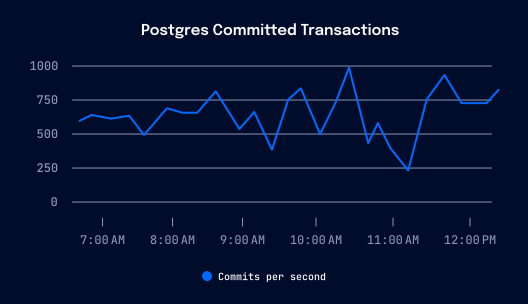
Cache hit ratio is the percent of reads from the database in-memory cache, as opposed to disk, and is ideally about 99%.
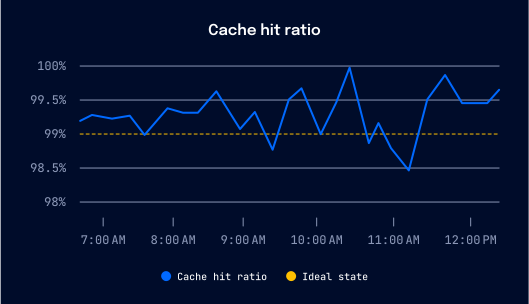
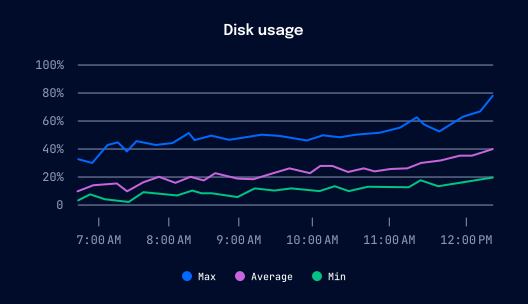
Managed Databases also include cluster resource utilization metrics like CPU, load average, memory usage, and disk usage.
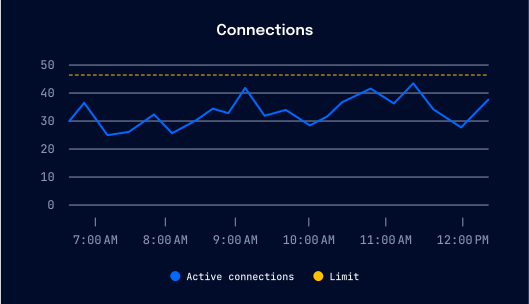
Disk usage is the percent of disk used by all nodes in the cluster. While it will fluctuate, you should maintain disk usage below 90%.

Predictable pricing
Always know what you’ll pay with monthly caps and flat pricing across all data centers. Spin up a cluster for just $15.15/month.

World-class support
Superior support services are designed to meet your needs whether you are a startup, large business, or anything in between.

Detailed documentation
Learn more about our log forwarding features, pricing, platform status, API, release notes, limitations, and more.
Managed Database resources
Discover all of our Managed Database resources all in one place. With thousands of tutorials and forum posts from our staff and a huge community of developers, answers are just a few clicks away.
Understanding Managed Databases
Explore the benefits of Managed Databases and whether they're right for you.
An introduction to queries in PostgreSQL
A guide to basic syntax of SQL queries as well as some of the more commonly employed functions and operations.
Understanding database sharding
Learn what sharding is, its main benefits, and a few common sharding methods.
Frequently asked questions about Managed Postegresql
What is DigitalOcean Managed Databases, PostgreSQL?
DigitalOcean Managed Databases for PostgreSQL is a fully managed, high-performance database cluster service that handles provisioning, configuration, maintenance, and updates, enabling users to avoid the manual tasks of installing and managing PostgreSQL themselves.
What features define the PostgreSQL managed service?
Key features include daily backups with point-in-time recovery (PITR), automated failover (and high availability if using standby nodes), end-to-end SSL encryption, deployment within a virtual private cloud (VPC), automatic software updates, logging, query insights, and metrics.
How does automated failover and high availability work?
All database clusters have automated failover; they automatically detect and replace degraded or failing nodes. High availability requires redundancy in addition to automatic failover. Database clusters must have at least one standby node to be highly available because standby nodes provide redundancy for the primary node.
Can I scale or add standby nodes to my PostgreSQL cluster?
Yes—DigitalOcean allows you to add standby replicas to enhance high availability, and clusters are designed to be scalable across regions with flexible node configurations. In addition to failovers, you can redirect reads to standby nodes in order to remove load from your primary.
How secure is the managed PostgreSQL service?
All managed PostgreSQL clusters use end-to-end SSL encryption for data in transit and can run inside VPCs with trusted sources, providing secure network segmentation and data protection.
How do I connect to a managed PostgreSQL database cluster?
You can connect using DigitalOcean’s CLI (doctl) or control panel to retrieve connection details. Standard clients like psql or GUI tools such as DataGrip can then be used to connect—once you've added your local IP to the trusted sources list.
How can I migrate or import an existing PostgreSQL database?
Continuous migration replicates updates in real time via logical replication, ideal when the source DB remains active.
Importing a dump uses tools like pg_dump and pg_restore for snapshot-style migration, especially when superuser permissions aren't available.
Can I install PostgreSQL extensions on DigitalOcean-managed clusters?
Is backup and point-in-time recovery available?
Absolutely—daily automatic backups are included, with support for PITR (point-in-time recovery), allowing you to restore your database to a specific time if needed.
What operational benefits does using a managed PostgreSQL service provide?
Using a managed service significantly reduces operational overhead by removing the need for manual installation, patching, backups, and infrastructure maintenance. It also improves reliability, scalability, security, and cost-efficiency for teams that want to focus on development rather than database administration.
Start building today
From GPU-powered inference and Kubernetes to managed databases and storage, get everything you need to build, scale, and deploy intelligent applications.